.png)
Categories
Zoning, Permits, Real Estate, Real Estate Fees, Real Estate Market Trends, Real Estate Tips, Property taxes, Recession, Long Term Rentals, Land Development, Interest Rates, Housing Trends, Housing market, Housing crisis, Homes for Sale, Homebuyer Tips, Home Prices, Buying Land, Buying Dirt, Buyer market, Buying Tips & Resources, Wealth Building through Real Estate, Wealth BuildingPublished May 19, 2026
How One Permit Mistake Can Cost You Hundreds of Thousands

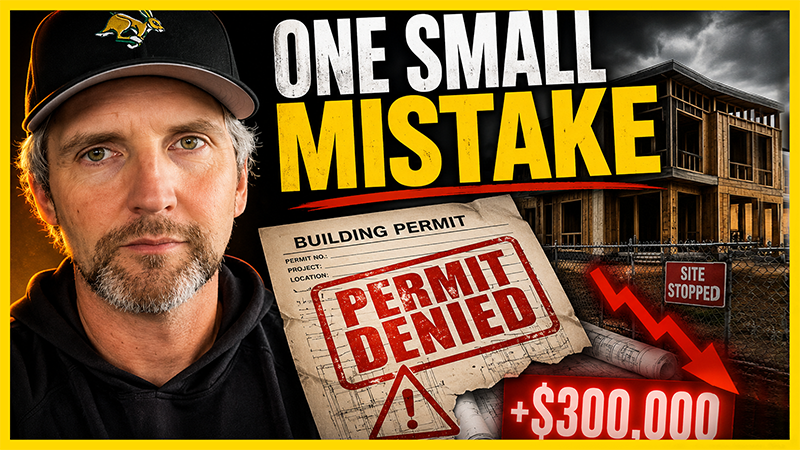
One Small Permit Mistake Can Cost You Hundreds of Thousands
The riskiest moment in a commercial real estate deal isn't signing the lease, it's discovering after the money is committed that you're not actually allowed to use the building for what you intended. Zoning and permitting mistakes in commercial real estate rarely cost a few thousand dollars; they can cost six figures, through forced remodels, sprinkler system upgrades, parking lot requirements, change-of-use permits, delayed openings, or in the worst case, finding out you legally can't operate your business there at all. The mistake almost always traces back to one bad assumption: that a building's previous use automatically makes your intended use acceptable too. It doesn't.
In commercial real estate, zoning and permitting mistakes do not usually cost you a few thousand dollars. They can cost you your entire project.
We are talking six figures.
Delayed openings.
Forced remodels.
Sprinkler systems.
Parking lot upgrades.
Change-of-use permits.
Or in worst-case scenarios, discovering you legally cannot operate your business there at all.
And the scary part is this happens constantly because business owners assume a building’s previous use automatically makes their use acceptable too.
It does not.
One of the biggest mistakes people make is signing long-term leases or buying buildings before fully confirming the property can legally support their intended use.
That sounds obvious.
But it happens all the time.
A business owner finds the perfect space. Great location. Decent parking. Affordable rent. Maybe the previous tenant was something similar, so they assume everything is fine.
Then the city steps in and says:
“You need a change-of-use permit.”
Or worse:
“You need to bring the entire property up to current code.”
That is when the financial bleeding starts.
One of the most misunderstood concepts in commercial real estate is that cities care less about what the building used to be and more about what the building is becoming now.
Sometimes even tiny operational changes trigger major compliance requirements.
A former church becoming a private school.
A retail shop becoming a restaurant.
A warehouse becoming a fitness studio.
A small office becoming a daycare.
To normal people, those changes sound minor.
To city planning departments, those changes can trigger an avalanche of requirements involving parking, landscaping, accessibility, occupancy loads, fire systems, utilities, traffic studies, and environmental reviews.
And cities do not care whether you already signed the lease.
That part is your problem.
One example discussed in the transcript involved a former church property transitioning into a private school. Same building. Same parking lot. Minimal physical changes.
Sounds simple, right?
Not even close.
That “small” change triggered requirements for a $300,000 sprinkler system plus curb, gutter, and sidewalk upgrades along the frontage of the property.
Three hundred thousand dollars.
For a building that had already existed for decades.
That is the kind of financial grenade that wipes out small businesses before they even open their doors.
And here is where things get even more frustrating.
Many business owners assume they can simply ask the city upfront and get a reliable answer.
Not exactly.
Cities often provide preliminary guidance through something called a pre-application meeting, or “pre-app.” These meetings are extremely valuable and absolutely necessary, but they are not binding guarantees.
Why?
Because codes change.
Interpretations change.
Staff changes.
Political priorities change.
A city planner might tell you one thing during an early conversation, but until a formal vesting application is submitted, nothing is fully locked in.
That means a project that looked straightforward six months ago can suddenly become far more expensive under new regulations.
This is why experienced developers obsess over due diligence before committing capital.
The average small business owner often does not.
And that gap is where disasters happen.
The transcript also highlights another brutal reality most people never think about: vacant properties can reset under newer code requirements.
This catches people constantly.
There was an example involving a church purchasing a building that had previously been used as a church. Sounds easy enough.
Except the building had sat vacant for more than six months.
That triggered a completely different permitting pathway under updated regulations, forcing the new buyer into a conditional use permit process before they could operate.
Same use.
Same building.
Different rules because of vacancy timing.
That delayed the opening timeline and added additional costs that could have blindsided the buyer if they had not investigated beforehand.
And that is really the lesson here.
The permitting process is not just bureaucracy. It is risk management.
Cities operate under layers of zoning laws, occupancy rules, land-use regulations, fire codes, accessibility standards, and infrastructure requirements that most business owners never even realize exist until they are deep into a project.
That is why experienced developers and consultants spend so much time on entitlement work before construction ever begins.
The smart move is not hoping the city says yes later.
The smart move is identifying the problems before money gets trapped.
And yes, this absolutely applies outside Washington State too.
While the conversation focused heavily on Washington because that is where much of the business activity occurs, these issues happen nationwide.
In many states, zoning and permit requirements are becoming even stricter as cities push updated environmental standards, parking requirements, accessibility mandates, density changes, and infrastructure improvements.
The result is that small business owners are increasingly walking into commercial real estate deals without realizing how much hidden regulatory risk exists beneath the surface.
The brutal truth is that one overlooked permit issue can easily destroy years of savings.
Not because the business idea was bad.
Not because demand was weak.
But because nobody fully verified whether the property legally worked before signing the deal.
That is why pre-app meetings, zoning reviews, change-of-use evaluations, and certificate of occupancy verification are not optional steps.
They are survival steps.
Especially in today’s environment where construction costs, interest rates, insurance premiums, and city fees are already crushing margins.
One permit mistake today does not just create inconvenience.
It can create a financial catastrophe.

Anton Stetner
| Anton Stetner & RESG | Keller Williams North Sound
or another way