.png)
Categories
Washington State, Washington State Real Estate, Wealth Building, Wealth Building through Real Estate, Seattle Real Estate, Real Estate Tips, Real Estate Fees, Real Estate Market Trends, ADU, 4 Bedroom Homes, 3 Bedroom Home, Buying Tips & Resources, DADU, Home Prices, Homes for Sale, Housing crisisPublished December 8, 2025
Washington Is NOT Growing, Population is Declining and What this means for Real Estate

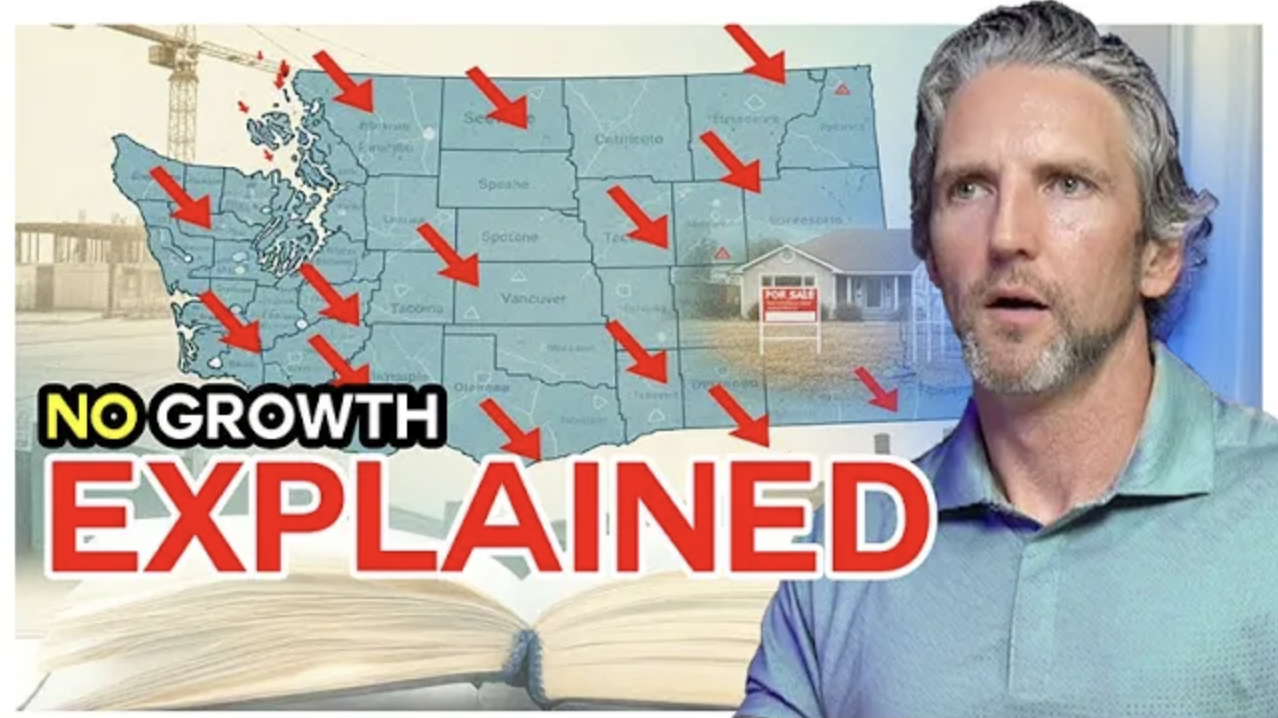
Is Washington State Really Growing? The Data Says “Not Like You Think”
Every time someone says Washington State is not growing, the comments light up. People pull a quick Google result, skim a headline, or ask ChatGPT one question and call it a day. That is first-layer thinking.
So let’s go three layers deep.
Because yes, Washington’s population number is still going up. But the reason it is going up matters more than the headline. And once you understand the reason, you see the actual risk forming under the surface.
The headline growth hides a deeper problem
Washington’s population is still increasing, but natural population growth has basically collapsed. That means we are not growing because Washingtonians are having more babies than we are losing to age.
We are growing almost entirely because of net migration. And more specifically, international migration.
The Washington Office of Financial Management shows that in 2024, about 69,300 of the state’s population gain came from net migration, while only 15,000 came from natural increase (births minus deaths). In other words, migration is doing the heavy lifting, not families growing here.
That is not how a stable, self-sustaining population behaves. That is a state leaning on a single pillar to hold up the whole house.
Natural growth is shrinking fast
Back in 2018, Washington was adding people both ways. We were still having enough babies to create real internal momentum.
By 2024, that internal momentum got cut in half.
According to OFM, the state’s natural increase dropped from around 31,000 in 2018 to about 15,000 in 2024. Migration also slowed, from roughly 88,000 net migrants in 2018 to about 70,000 in 2024.
So yes, the number still rises. But the engine is smaller and it is sputtering.
Washingtonians have been leaving since Covid
This is the part people feel in real life and the data confirms in trend.
Since Covid, Washington has seen sustained domestic outmigration, especially from the Seattle metro. People are leaving for cheaper, looser, simpler states. High cost of living, rising taxes, political instability, and housing unaffordability are doing what they always do. They push the middle class out.
Even Seattle’s “growth” has been increasingly dependent on international inflow rather than Americans moving here from other states.
The lived experience lines up with the math.
Who is replacing the people leaving?
Tech-driven international migration.
Washington’s economy has become heavily dependent on high-income tech workers moving in, while long-time Washingtonians move out or decide they cannot afford to build a life here.
Seattle’s dependence on Amazon and Microsoft is strong enough that when tech hiring slows, the entire metro feels it, from restaurants to commercial vacancy to housing demand.
That is the risk. If your population growth is reliant on mobile high earners who can leave instantly, your tax base becomes unstable and your housing market becomes volatile.
The affordability trap is the real villain
Here is the core loop Washington is stuck in:
- We do not build enough housing.
- Supply stays artificially tight.
- Prices and rents rise faster than incomes.
- Washingtonians leave.
- We lean harder on international migration to keep the number up.
The Growth Management Act plus zoning restrictions and slow permitting timelines squeeze land supply and make building painfully expensive. That drives up housing costs, which drives out families, which drives down natural growth.
This is not a mystery. It is policy math.
What happens if tech slows down?
This is the part people are not asking enough.
If Washington’s growth relies on tech inflow, what happens when:
- the tech sector slows,
- AI reduces hiring needs,
- visa rules tighten,
- or companies shift growth elsewhere?
Seattle is already dealing with a tech cooling cycle and ripple effects across the local economy.
If the inflow slows while the outflow continues, Washington’s population trend can flip negative.
And when population trends flip negative, real estate does not stay cute and stable.
What this means for real estate
Right now, most of the Seattle metro is appreciating around the rate of inflation. Call it 2 to 5 percent depending on area. That is slow, but not bad.
The bigger driver is rates. The 10 year treasury is trending down and the Fed is signaling cuts. When debt gets cheaper, buyers come back and prices outpace inflation again.
So yes, if rates fall like the market expects, 2026 should show stronger price appreciation than 2025.
For investors and buyers, that means:
- If you want in, deal season is still here.
- Rental demand should stay strong because affordability keeps pushing people into renting.
- Locations near major employment cores remain the safest long-term plays, especially if the tech pipeline holds.
But the long-term solution for the state is not “hope tech saves us.” It is building enough housing for normal families to stay.
The fix is unsexy, but obvious
If Washington wants real, stable growth again, we need three things:
- Build more housing.
Not just luxury units. Starter homes, townhomes, ADUs, density where people actually want to live. - Stop choking land development.
Faster permits, more buildable land, fewer bureaucratic bottlenecks. - Stop attacking small business and the middle class.
A strong middle class is how states grow naturally. Not by importing replacement population.
Do that, and Washington stops bleeding people. Do not do that, and we keep drifting toward a tech-dependent, affordability-crushed version of Silicon Valley 2.0.

Anton Stetner
| Anton Stetner & RESG | Keller Williams North Sound
or another way