
Categories
Real Estate, Real Estate Tips, Market UpdatesPublished October 14, 2026
Washington Natural Gas Ruling and PSE Rate Hikes: What It Means for Your Home (2026)

Washington’s Natural Gas Ruling and Rising Utility Bills: What Homeowners Need to Know
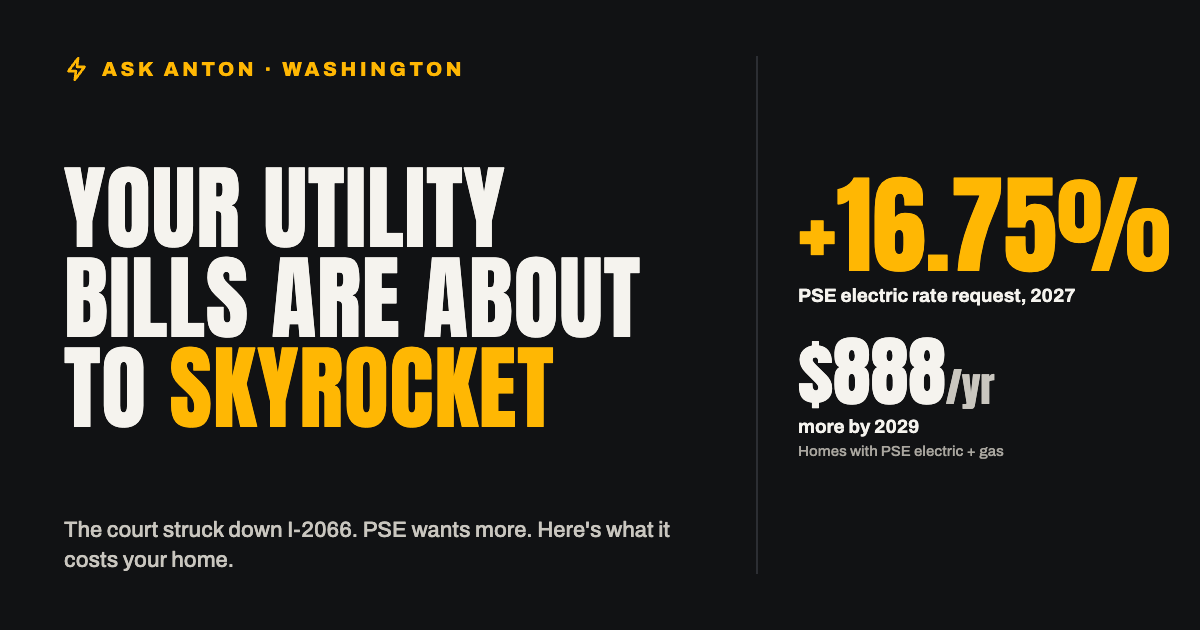
Key facts (as of October 2026): On September 17, 2026, the Washington Supreme Court struck down Initiative 2066 in a 6-3 decision, ruling that it violated the state constitution's single-subject rule. Puget Sound Energy has asked state regulators for residential electric increases of 16.75% in 2027, 3.76% in 2028 and 8.81% in 2029, after a roughly 12% increase in January 2026. The Utilities and Transportation Commission is expected to decide in January.
What did I-2066 do, and why was it struck down?
Voters approved I-2066 in November 2024 with about 52% of the vote. It protected access to natural gas, required utilities to keep serving eligible customers, and rolled back building and energy code provisions that made gas costly in new construction. The court found it combined several distinct subjects, which the constitution doesn't allow, so it struck the entire measure rather than parts of it.
This isn't the first time. Courts have struck down other voter-approved initiatives on similar grounds, including $30 car tabs (I-695 in 2000 and again in 2020), property tax limits (I-722, I-747), the two-thirds vote for tax increases (I-1053) and the sales tax cut (I-1366).
How much will utility bills go up?
For a typical PSE home using 800 kWh a month, PSE's request adds about $28 a month in 2027, $7 in 2028 and $16 in 2029. A typical gas customer would add about $14, $4 and $5 in those years. A home with both is looking at roughly $74 more a month, or about $888 a year, by 2029. Higher costs for carbon allowances under the Climate Commitment Act are part of what PSE passes through to customers.
Does this ban natural gas in existing homes?
Not today. You can generally replace a gas appliance like-for-like. But permitted remodels and additions, and all new construction, run into energy code requirements that make gas far more expensive to keep. Anton's concern is that future rules could push existing homes to retrofit.
What does electrification cost a homeowner?
These are Anton's estimates from building in Washington:
|
Item |
Estimated cost |
|---|---|
|
Panel upgrade, 100 to 200 amps |
$7,000–20,000 |
|
Heat pump |
$12,000–30,000 |
|
Electric water heater |
$3,000–6,500 |
|
Electric range |
$2,200–5,000 |
|
Full gas-to-electric conversion |
$20,000–60,000 |
|
Added cost per new home |
$15,000–30,000 |
Why natural gas matters for the grid
In 2024, about 55% of Washington's electricity came from hydropower and about 15% from natural gas. Hydro output is steady. Gas can ramp up during demand peaks, around 6 a.m. and 5–6 p.m., and during cold snaps when heat pumps lose effectiveness. Typical neighborhood transformers were sized for far less load than a fully electric home with a heat pump, water heater and EV charger.
What to check before you buy or sell
- Which utility serves the exact address (PSE, Snohomish County PUD, Seattle City Light)?
- How large is the electrical panel, and how much capacity is left?
- Which appliances run on natural gas?
- What would it cost to replace them during your ownership?
- For rentals, multifamily and HOA properties: who pays which utilities?
FAQ
Is natural gas banned in Washington? Not outright. New construction must meet energy codes that make gas significantly more expensive, and the I-2066 protections no longer apply.
When will PSE's 2027 rates take effect? If the UTC approves them, in early 2027. The commission can set rates different from what PSE requested.
Will homes with gas lose value? Not necessarily. In areas where gas stays affordable, a working gas system may become a selling point.
Watch the full podcast episode for Anton's complete breakdown.

Anton Stetner
| Anton Stetner & RESG | Keller Williams North Sound
or another way